
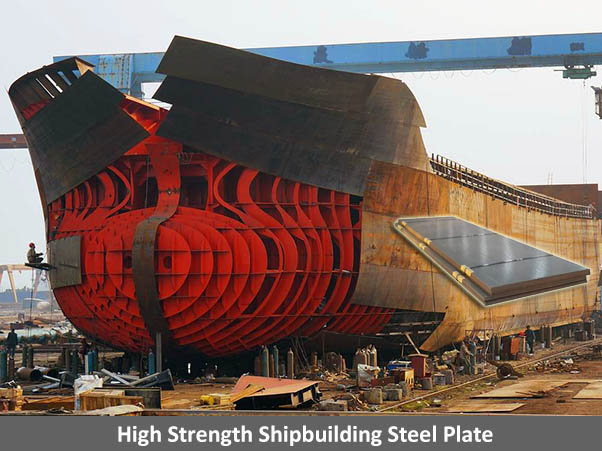
What is ShipBuilding Steel?
Grade and Chemical Composition (%)
| A | 0.22 | ≥ 2.5C | 0.10~0.35 | 0.04 | 0.4 | — | — | — |
| B | 0.21 | 0.60~1.00 | 0.10~0.35 | 0.04 | 0.4 | — | — | — |
| D | 0.21 | 0.60~1.00 | 0.10~0.35 | 0.04 | 0.04 | ≥0.015 | — | — |
| E | 0.18 | 0.70~1.20 | 0.10~0.35 | 0.04 | 0.04 | ≥0.015 | — | |
| AH32 DH32 EH32 | 0.18 | 0.70~1.60 0.90~1.60 0.90~1.60 | 0.10~0.50 | 0.04 | 0.04 | ≥0.015 | — | — |
| AH36 DH36 EH36 | 0.18 | 0.70~1.60 0.90~1.60 0.90~1.60 | 0.10~0.50 | 0.04 | 0.04 | ≥0.015 | 0.015~0.050 | 0.030~0.10 |
Shipbuilding steel grades vary based on their specific properties and intended use in ship construction. Some common grades include:
-
Grade A: This is the most common grade used in shipbuilding and typically has good weldability and toughness. It is suitable for the construction of hulls and other structural components.
-
Grade B: Similar to Grade A, Grade B steel is also used for hull construction and offers good weldability and toughness.
-
A36: This grade is known for its high strength and corrosion resistance. It is commonly used in the construction of ship decks and superstructures.
-
D36: Another high-strength grade, DH36 steel is used for hull construction in areas where greater strength is required.
-
E36: Similar to AH36 and DH36, EH36 steel offers high strength and corrosion resistance, making it suitable for shipbuilding applications in harsh environments.
-
Grade D: This grade is often used for structural components requiring moderate strength and toughness.
These grades are typically classified by organizations such as the American Bureau of Shipping (ABS) or other classification societies, which set standards for the properties and composition of shipbuilding steel grades.
Refer to knowledge base here
The properties required for shipbuilding steel vary depending on the specific application and the requirements of classification societies such as the American Bureau of Shipping (ABS), Lloyd's Register of Shipping (LR), and others. However, some general properties and characteristics of shipbuilding steel include:
-
High Strength: Shipbuilding steel needs to have high strength to withstand the stresses and strains experienced in marine environments. This ensures the structural integrity and safety of the ship.
-
Good Weldability: Shipbuilding steel should be easily weldable to facilitate the construction process and to allow for repairs and modifications throughout the service life of the ship.
-
Corrosion Resistance: Given the exposure to saltwater and harsh marine environments, shipbuilding steel should have good resistance to corrosion to prevent deterioration over time.
-
Toughness: Shipbuilding steel must be tough to withstand impact loads and other dynamic forces encountered during service, such as collisions with other vessels or structures.
-
Ductility: Ductility is important for shipbuilding steel as it allows for deformation without fracture, which is essential for absorbing energy during impact events.
-
Low Temperature Toughness: Ships may operate in cold environments, so shipbuilding steel should retain its toughness and ductility even at low temperatures to avoid brittle fracture.
-
Wear Resistance: Shipbuilding steel should have adequate wear resistance to withstand abrasion from factors such as wave action, floating debris, and contact with docks or other structures.
-
Formability: Shipbuilding steel must be formable to allow for the fabrication of complex shapes and structures required in ship construction.
-
Weight Efficiency: While strength is important, shipbuilders also seek materials that offer a balance of strength and weight to optimize the vessel's performance and fuel efficiency.
Different grades of shipbuilding steel may have variations in these properties to suit specific applications and environmental conditions. Common grades of shipbuilding steel include AH36, DH36, and EH36, which are classified based on their minimum yield strength and intended service conditions.
The module follows Google guidelines and adds FAQ schema.